Author: Furrvy Team
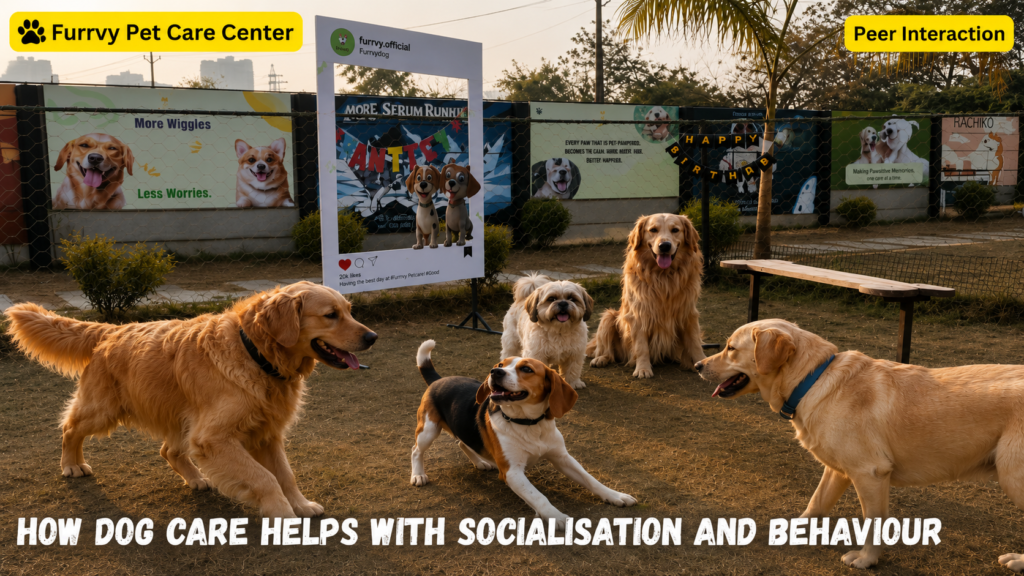
Regular, supervised time with other dogs during a dog’s early social development, generally up to around a year old, can help build calmer, more confident behaviour around dogs and people later in life. Daycare is one way to provide this consistently, though it works best alongside other everyday socialisation, not as a replacement for it.
Furrvy is a pet daycare and boarding centre in Gurgaon (also Gurugram) with centres in Sector 58 and Sector 27.
Quick Facts: Daycare and Socialisation
| Detail | Information |
|---|---|
| Key socialisation window | Roughly up to a year old, most sensitive early on |
| What daycare offers | Regular, supervised exposure to other dogs |
| Best paired with | Everyday walks, varied environments, calm handling |
| Grouping | By size and temperament, adjusted as needed |
| Not a fix for | Existing fear or aggression, which needs professional support |
Can Daycare Really Help With Socialisation?
Daycare can support socialisation by giving a dog repeated, supervised exposure to other dogs in a structured setting, which is genuinely useful during the early social development window. It is one part of a broader picture, not a single solution on its own.
A dog that only ever meets other dogs at daycare, and nowhere else, still benefits, but a dog that also gets varied everyday experiences tends to build broader confidence.
What Is the Social Development Window in Dogs?
Puppies are generally considered most receptive to new experiences, including meeting other dogs, roughly up to around a year old, though this varies by individual and breed. Positive experiences during this stage tend to shape adult behaviour more strongly than the same experiences later in life.
This does not mean an older dog cannot still benefit from socialisation, but the effect and ease of building comfort around other dogs is often greater earlier on.
How Does Daycare Group Dogs for Socialisation?
Dogs are typically grouped by size and temperament, so a nervous or smaller dog is not thrown in with a boisterous, much larger one straight away. Groupings are usually adjusted through the day if a dog seems overwhelmed or tired.
This structured approach is one advantage daycare has over unsupervised or unpredictable encounters, since a trained eye can step in before a situation becomes stressful for a dog.
Will Daycare Fix an Aggressive or Fearful Dog?
Not on its own. A dog with existing fear or aggression around other dogs generally needs a proper behavioural assessment and, often, professional support, rather than simply being placed in a group setting and hoping it improves. Daycare works best for dogs that are reasonably comfortable or mildly nervous, not for dogs with a history of serious reactivity.
The American Kennel Club recommends speaking with a vet or a qualified behaviourist before placing a fearful or reactive dog into a group daycare environment.
Does Every Dog Need Daycare for Good Socialisation?
No. Regular walks, visits to dog friendly spaces, and calm exposure to new people and environments can also build a well socialised dog, with or without daycare. Daycare is one option among several, useful particularly for owners who want consistent, supervised social time built into a daily routine.
If your dog already gets varied social exposure elsewhere, daycare may add less than it would for a dog with limited opportunities to meet others.
What Signs Suggest Daycare Is Helping?
A dog that seems increasingly relaxed around other dogs over time, settles into new groups more easily, and shows less anxious behaviour both during and after visits is generally responding well. Some dogs take longer to settle in than others, and a slow start does not necessarily mean daycare is the wrong fit.
The RSPCA notes that socialisation is an ongoing, gradual process rather than something achieved in a single visit or a fixed number of sessions.
Frequently Asked Questions
Does dog daycare really help with socialisation?
It can, by providing regular supervised exposure to other dogs during a dog’s social development, though it works best alongside other everyday socialisation rather than as the only source of it.
What is the key socialisation age for dogs?
Roughly up to around a year old, though this varies by dog and breed, with early positive experiences often having a stronger long term effect.
Can daycare fix aggressive or fearful behaviour?
Not reliably on its own. A dog with existing fear or aggression usually needs a proper behavioural assessment, sometimes with a qualified professional, rather than group daycare alone.
Is daycare necessary for good socialisation?
No, it is one option among several. Regular walks and varied everyday experiences also contribute to a well socialised dog.
How will I know if daycare is helping my dog socially?
Look for signs the dog is settling more easily into groups and showing less anxious behaviour over time, though this can take longer for some dogs than others.
Give Your Dog Regular, Supervised Social Time
Furrvy runs dog daycare at its Sector 58 and Sector 27 centres in Gurgaon, with dogs grouped by size and temperament. To try a visit, message us on WhatsApp: 💬 6355093941.
Related reading: Dog Daycare in Gurgaon | Puppy Daycare in Gurgaon | Signs Your Dog Needs Daycare | Dog Daycare Safety